


Hull Cleaning and Propeller Polishing Thailand


Hull Cleaning and Propeller Polishing Thailand
Commercial vessels operating in tropical waters are exposed to rapid marine growth accumulation on hull surfaces, propeller assemblies, sea chests, gratings, bilge keels, rudder areas, and other underwater appendages. If not managed properly, biofouling can increase hull resistance, reduce propulsion efficiency, affect vessel performance, and create operational issues for shipowners, fleet managers, and technical departments.
MaxiDive provides professional hull cleaning and propeller polishing in Thailand, supporting commercial vessels with underwater inspection, marine growth removal, sea chest cleaning, propeller surface improvement, and technical photo and video documentation.

Underwater Hull Cleaning and Marine Growth Removal
During this project, MaxiDive’s diving team carried out underwater hull cleaning and inspection at anchorage in Thailand. The operation focused on removing marine growth from key underwater areas and documenting the vessel’s condition before, during, and after cleaning.
The inspected hull areas included:
Bulbous bow
Vertical sides
Flat bottom
Hull plating
Bilge keels
Sea chest gratings
Transducers
Drain plugs
Rudder assemblies
Propeller assemblies
Rope guard and stern shaft area
The inspection confirmed that the hull was cleaned to a very low level of remaining marine growth, while underwater findings were documented with photographic and video evidence for the client’s technical records.
Sea Chest and Grating Cleaning
Sea chest gratings are critical underwater components because blockage from marine growth can restrict water flow to onboard systems. During the underwater operation, MaxiDive inspected the high sea chest, low sea chest, and emergency sea chest gratings.
The gratings were found with different levels of marine growth blockage before cleaning. Divers cleaned the gratings and confirmed that they were secure and fastened in place, with no movement observed.
Sea chest cleaning is an important part of underwater vessel maintenance because it helps support reliable water intake performance and reduces the risk of operational restrictions caused by biofouling accumulation.
Propeller Polishing and Surface Condition
The propeller assembly was inspected for entanglement, visible damage, cracks, cavitation, and surface roughness. No evidence of rope entanglement was observed. The stern shaft area was also checked, with no suspected damage identified.
The propeller surface was polished to improve blade smoothness and support better propulsion efficiency. Propeller polishing helps reduce surface roughness caused by marine growth, deposits, and operational exposure.
A properly polished propeller can support:
Improved vessel performance
Reduced unnecessary drag
Better propulsion efficiency
Lower vibration risk from uneven fouling
More reliable underwater condition records

Rudder and Appendage Inspection
The rudder assembly was inspected visually, including weld seams, drain plugs, upper connection areas, and general surface condition. The rudder was cleaned and checked for visible abnormalities, leakage, corrosion, and structural concerns.
The inspection also included appendages such as bilge keels and transducers. These areas are important because they are often affected by fouling accumulation and may require careful inspection to confirm that no damage, movement, or abnormality is present.
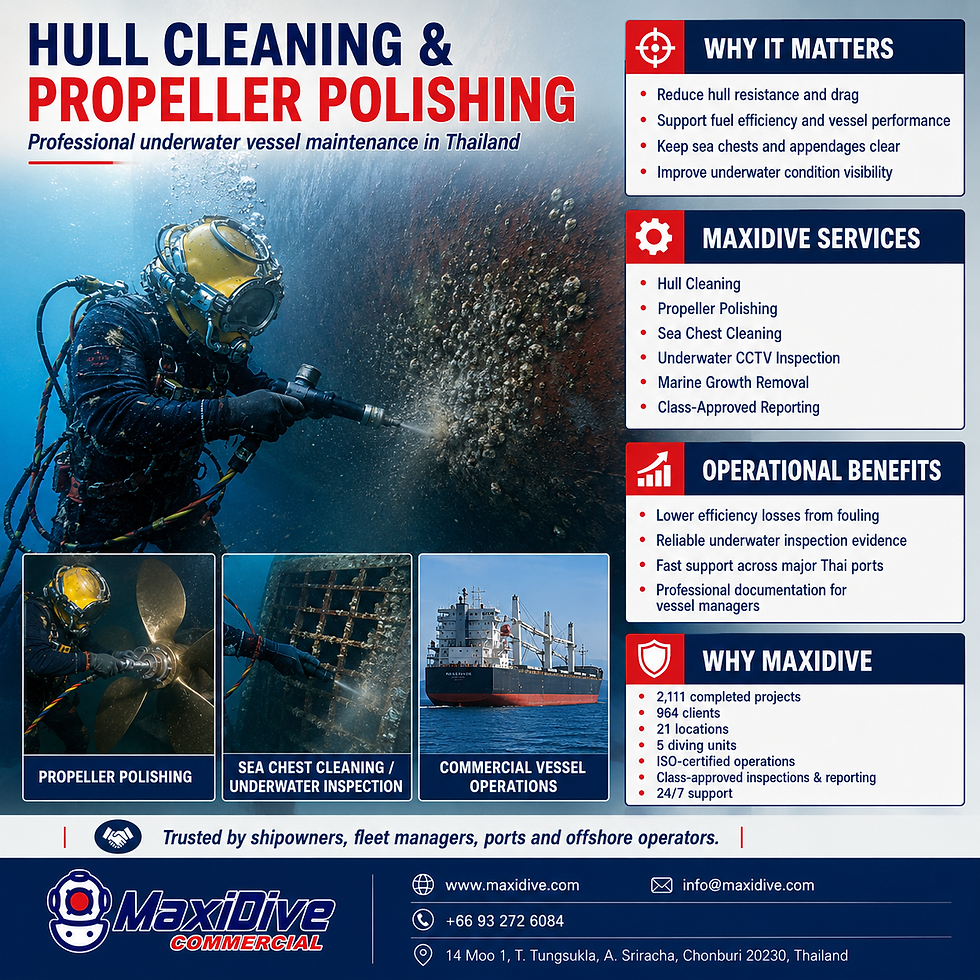
Why Hull Cleaning and Propeller Polishing Matter
Hull cleaning and propeller polishing are not only cosmetic underwater maintenance tasks. They directly support operational performance and technical reliability.
For commercial vessels, regular underwater maintenance can help:
Reduce hull resistance and drag
Support fuel efficiency and vessel performance
Keep sea chest gratings clear from blockage
Maintain clean and inspectable underwater surfaces
Support technical decision-making with photo and video evidence
Reduce operational delays caused by underwater fouling issues
In tropical waters such as Thailand, marine growth can develop quickly. Regular inspection and cleaning help vessel operators maintain underwater condition awareness and plan maintenance more effectively.
Professional Commercial Diving Support in Thailand
MaxiDive provides commercial diving services across major Thai ports and anchorages, including Laem Chabang, Sriracha, Sattahip, Koh Si Chang, Map Ta Phut, Bangkok Port, and Songkhla.
Our underwater services include hull cleaning, propeller polishing, underwater CCTV inspection, sea chest cleaning, rudder and appendage inspection, class-approved reporting support, and emergency underwater repair assistance.
With 2,111 completed projects, 964 clients, 21 locations, and 5 diving units, MaxiDive continues to support shipowners, fleet managers, marine superintendents, and technical teams with reliable underwater services in Thailand.
Conclusion
This hull cleaning and propeller polishing project demonstrates the importance of regular underwater vessel maintenance for commercial ships operating in Thai waters. By combining underwater cleaning, inspection, propeller polishing, sea chest cleaning, and technical reporting, MaxiDive helps clients maintain vessel performance, operational reliability, and clear underwater condition records.
For professional hull cleaning and propeller polishing in Thailand, MaxiDive provides experienced commercial diving teams, technical documentation, and responsive support across major ports and anchorages.


Comments