


Full Hull Cleaning and Propeller Polishing with Final Condition Verification at Koh Si Chang Anchorage


MaxiDive completed Full Hull Cleaning and Propeller Polishing for a commercial vessel at Koh Si Chang Anchorage, Thailand. The underwater work was carried out to clean the hull, verify underwater component condition and polish the propeller to a documented final surface standard.
The operation was performed under calm sea state conditions with approximately 3 meters of underwater visibility. MaxiDive’s commercial diving team used TG-7, GoPro-12, hydrophilic tools, hand tools and supporting equipment to complete the cleaning, inspection and documentation scope.
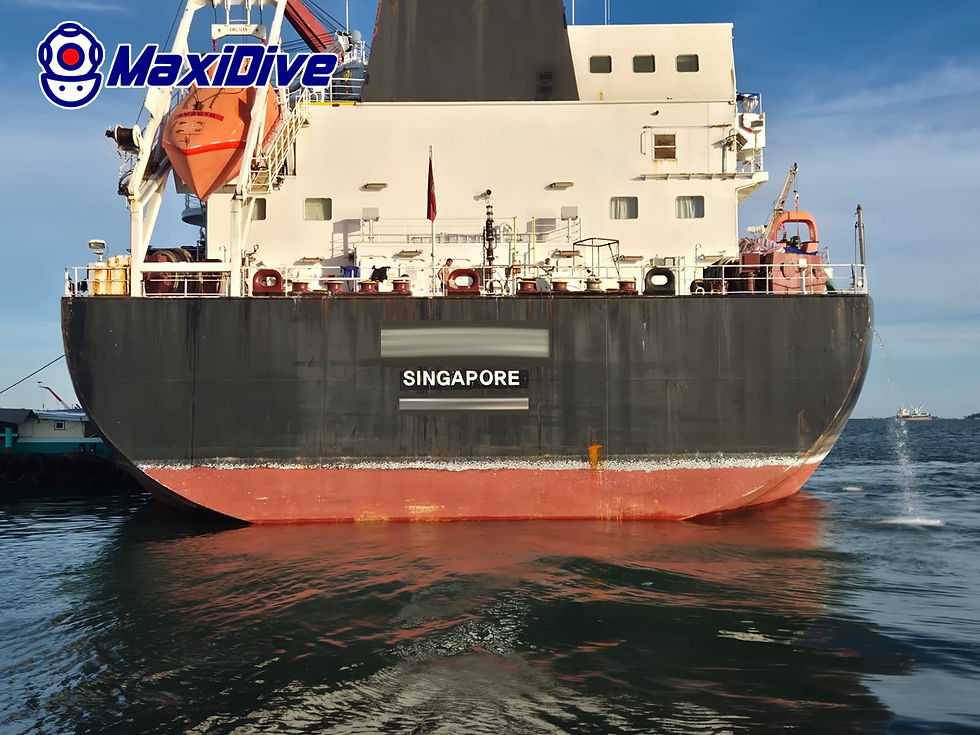
Full Hull Cleaning and Propeller Polishing: Service Scope
The requested underwater work focused on full hull cleaning and propeller polishing, followed by final underwater condition verification. MaxiDive’s divers cleaned and documented key underwater areas while the vessel remained afloat.
The main work scope included:
full hull cleaning;
hull plating inspection;
vertical side and flat bottom condition review;
sea chest grating inspection;
appendage inspection;
discharge and drain plug checks;
bilge keel condition verification;
ICCP condition review;
propeller polishing;
rudder assembly inspection;
underwater photo/video documentation.
This type of underwater service helps vessel operators maintain cleaner underwater surfaces, document final vessel condition and support maintenance planning without immediate dry docking.

Hull Plating Condition
The bow area showed marks consistent with anchor chain contact. The vertical sides were reported free from contact damage, and the flat bottom was free from signs of grounding.
The stern arrangement was reported free from cracks and strong welding irregularities. The overall hull plating weld seams were recorded in good condition.
These findings confirm that the underwater inspection did not identify significant hull plating damage or structural anomalies in the inspected areas.

Appendage Inspection
The underwater inspection also covered appendages and associated components. The transducers were reported free from damage.
All sea chest gratings were secure and fastened in place. One bolt was reported missing from the starboard side grating and one bolt was reported missing from the port side grating.
The overall discharges were in good condition. All visible drain plugs were free from signs of leakage. All sections of the bilge keels were reported in normal profile, and the ICCP system was reported free from damage.
Appendage inspection provides important technical confirmation for the vessel’s maintenance record and helps identify components requiring future monitoring.
Propeller Polishing Result
The propeller assembly was inspected and polished as part of the underwater service scope. The propulsion area was reported free from entanglement, and the seal assembly was free from leakage.
The rope guard was recorded in fair condition. The propeller was polished to grade “A” according to Rubert Scale. The hub and boss were free from contact damage and abnormalities, and the boss cap was secure with keepers intact.
Polishing the propeller to Rubert “A” provides a smoother blade surface condition and supports vessel efficiency by reducing surface roughness.
Rudder Assembly Verification
The rudder assembly was also inspected. No movement of the rudder was detected. Visual inspection showed the rudder in good condition.
The anodes were reported in poor condition, with approximately 50–100% depletion. No evidence of cracks, contact damage or abnormalities was detected during the rudder inspection.
This information gives the vessel’s technical team a clear basis for future maintenance planning, especially regarding anode replacement intervals.
Why Full Hull Cleaning and Propeller Polishing Matter
Marine growth on hull plating, appendages, sea chest gratings and propeller surfaces can increase drag, affect vessel performance and create additional maintenance requirements.
Full Hull Cleaning and Propeller Polishing help vessel operators:
remove marine growth from underwater surfaces;
maintain cleaner hull condition;
improve propeller blade surface condition;
document appendage and rudder status;
identify anode depletion and minor component issues;
support operational efficiency;
plan further maintenance without immediate dry docking.
Final condition verification is important because it provides the vessel’s technical team with documented evidence of underwater condition after cleaning and polishing.
MaxiDive Commercial Diving Support in Thailand
MaxiDive provides hull cleaning, propeller polishing, underwater inspection, sea chest cleaning, underwater blanking, emergency underwater repair and commercial diving support for vessels operating in Thai ports and anchorages.
This Full Hull Cleaning and Propeller Polishing operation at Koh Si Chang Anchorage demonstrates MaxiDive’s ability to combine underwater cleaning, propeller surface improvement and technical documentation in one controlled service scope.
Conclusion
The Full Hull Cleaning and Propeller Polishing operation at Koh Si Chang Anchorage provided the vessel’s technical team with cleaned underwater surfaces, documented appendage findings and verified propeller polishing results.
MaxiDive’s commercial diving team completed the requested work scope, polished the propeller to Rubert “A” and documented the underwater condition to support maintenance planning while the vessel remained afloat.


Comments