


Underwater Transducer Inspection Thailand: What to Check on Speed Log, Echo Sounder and Sensor Areas


Modern commercial vessels depend on underwater sensors for navigation, depth measurement, speed monitoring and other operational data.
Speed logs, echo sounders and other hull-mounted transducers operate below the waterline, where their external surfaces and mounting areas are exposed to seawater, marine growth, coating deterioration and possible mechanical contact.
A professional underwater transducer inspection Thailand provides direct visual evidence of the external condition of these components while the vessel remains afloat.
The objective is not to test the electronics or confirm calibration. Instead, underwater visual inspection documents the physical condition of accessible sensor surfaces, mounting areas and surrounding hull plating so that vessel managers and technical teams can determine whether further investigation is required.

Underwater Transducer Inspection Thailand: What Should Be Checked?
A structured inspection should examine both the transducer itself and the surrounding installation area.
Depending on vessel design and equipment arrangement, inspection may include:
speed log transducers;
echo sounder transducers;
depth-sounding sensors;
other hull-mounted underwater sensors;
transducer faces;
mounting plates;
retaining rings;
visible fasteners;
surrounding hull coating;
marine growth;
signs of impact;
corrosion;
exposed steel;
visible displacement or misalignment.
The inspection scope should always reflect the actual vessel arrangement because transducer design and positioning vary between ships.
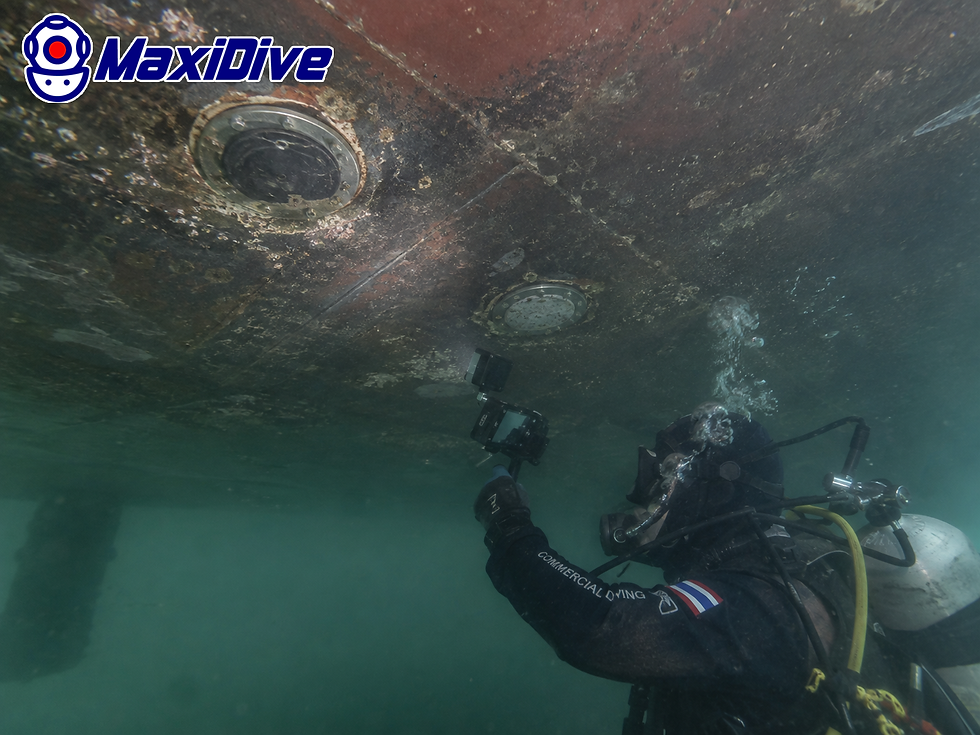
Where Are Underwater Transducers Usually Located?
Underwater transducers are generally installed where they can operate with minimal interference from air bubbles, turbulence and disturbed water flow.
On many commercial vessels, speed log and echo sounder transducers are positioned in the bottom shell or another dedicated underwater area specified by the vessel’s design.
Some units are nearly flush with the hull surface, while others use dedicated mounting arrangements or housings.
For this reason, a realistic underwater inspection should show the commercial diver working beneath the hull or around the designated sensor area — not inspecting a row of decorative sensors mounted on the vertical side of the vessel.
The exact arrangement depends on vessel design, sensor manufacturer and original installation specification.

Transducer Face Condition
The exposed sensor face is one of the first areas to inspect.
The commercial diver should visually document:
cracks;
scratches;
impact marks;
surface deterioration;
missing material;
unusual deformation;
accumulated marine growth;
visible contamination.
The sensor face should be photographed from several angles where possible.
Even minor damage can be important to record because the external surface forms part of the acoustic or measurement interface between the sensor and surrounding water.

Marine Growth on Underwater Sensors
Marine growth can develop around sensor surfaces, retaining rings and adjacent hull plating.
Typical growth may include:
slime;
algae;
barnacles;
calcareous deposits;
tube worms;
other hard marine growth.
Heavy growth may obscure the transducer face or make visual assessment difficult.
The inspection report should record how much of the component could actually be seen rather than assume satisfactory condition beneath marine growth.
Marine growth may also influence sensor performance in some situations, but underwater visual inspection alone cannot determine the extent of any operational effect.
Mounting Plate and Retaining Ring
The area where the transducer interfaces with the hull is equally important.
The commercial diving team should document the mounting plate, retaining ring or other visible external fixing arrangement.
Inspection should consider:
secure positioning;
missing or loose fasteners;
visible corrosion;
deformation;
damaged mounting surfaces;
abnormal gaps;
disturbed coating;
evidence of impact.
A transducer can appear visually intact while the surrounding mounting area shows signs of contact or deterioration.
This is why inspection should never focus only on the sensor face.
Visible Fasteners
Where external fasteners are present and visible, they should be documented individually.
The commercial diver should look for:
missing bolts;
loose-looking fasteners;
damaged heads;
significant corrosion;
abnormal spacing;
visible movement around the fixing area.
Visual inspection cannot confirm torque or internal fastening condition, but it can identify obvious external abnormalities that require further technical review.
Surrounding Hull Coating
The hull coating around a transducer may provide useful information about the installation area.
Inspection should document:
coating breakdown;
abrasion;
bare steel;
corrosion;
cracking around the installation;
unusual staining;
local mechanical contact marks.
Damage surrounding the transducer may indicate contact with an external object even when the sensor itself remains apparently intact.
The relationship between the sensor and the surrounding hull should therefore always be included in overview photography.
Mechanical Contact and Impact Damage
Underwater transducers located near the bottom shell can be exposed to damage during grounding, contact with floating or submerged objects, or other operational incidents.
Possible visual indications include:
chipped sensor surfaces;
cracked covers;
bent mounting components;
scraped coating;
damaged fasteners;
deformation;
displacement;
exposed steel;
disturbed marine growth.
After confirmed or suspected grounding, transducer areas should be included in the underwater condition survey together with flat bottom plating, bilge keels and other low-level appendages.
Possible Misalignment or Displacement
One important inspection objective is determining whether the visible external arrangement appears normal.
A transducer that appears shifted, tilted or displaced relative to its mounting surface should be documented carefully.
Useful evidence includes:
wide-angle photographs showing overall position;
close-up images of the sensor;
mounting plate condition;
surrounding hull reference;
video showing the component from several angles.
The diving team should describe what is visually observed without claiming that electronic alignment or calibration has been confirmed.
Echo Sounder Transducer Inspection
Echo sounder systems depend on underwater acoustic transmission and reception.
External underwater inspection can document:
transducer face condition;
marine growth;
physical impact;
surrounding coating;
external mounting integrity;
visible corrosion;
possible displacement.
However, a visual underwater inspection cannot confirm signal quality, frequency performance, calibration or internal electronic condition.
Those functions require appropriate onboard or specialist testing.
Speed Log Transducer Inspection
Speed log transducers can also be visually examined underwater.
Depending on the system design, the external inspection may document:
sensor surface;
mounting area;
external fasteners;
surrounding hull;
visible marine growth;
physical contact marks;
possible displacement;
external corrosion.
If the vessel reports unusual speed readings, underwater inspection can help determine whether an obvious external physical condition is present.
It should not be presented as proof that the sensor itself is electrically or electronically defective.
Inspection After Grounding or Bottom Contact
Transducer inspection is particularly relevant after grounding or suspected contact with the seabed.
Sensors located in lower hull areas may be exposed even when the main plating shows limited visible damage.
After such an event, the inspection should look for:
direct impact marks;
scraping;
broken sensor surfaces;
damaged mounting rings;
displaced components;
missing fasteners;
surrounding coating abrasion;
bare steel;
deformation.
These findings can then be evaluated alongside the condition of flat-bottom plating and other underwater appendages.
Overview Photography Is Essential
A close-up image of a sensor is useful, but it does not show where the component is located.
Professional documentation should therefore include both overview and detailed images.
Overview photographs help establish:
location on the vessel;
orientation;
relationship to hull plating;
surrounding structures;
general installation condition.
Close-up photographs then document:
surface condition;
fasteners;
corrosion;
cracks;
marine growth;
individual defects.
This combination creates a much stronger technical record.
Underwater CCTV and Video Documentation
Continuous underwater video can provide additional context that still photographs cannot.
Video documentation can show:
approach to the sensor area;
general hull condition;
exact location;
multiple viewing angles;
relationship between sensor and mounting surface;
extent of marine growth;
surrounding hull condition.
Clear narration or later structured reporting can then connect each visual observation to the relevant vessel area.
Why Previous Inspection Records Matter
A single underwater survey shows condition at one point in time.
Repeated inspection records provide considerably more value because they can show whether an observed condition is:
unchanged;
progressing;
newly developed;
associated with a recent incident.
For example, comparison may help determine whether coating loss around a transducer was already present during an earlier survey or appeared later.
Consistent photo angles and location references improve the value of this comparison.
What Underwater Visual Inspection Cannot Confirm
An important part of professional reporting is defining the limits of the inspection.
Underwater visual inspection can document external physical condition.
It cannot independently confirm:
electronic performance;
sensor calibration;
signal quality;
internal wiring condition;
internal water ingress;
onboard display accuracy;
software configuration.
A sensor may look externally satisfactory but still have an internal technical fault.
Likewise, visible external damage does not automatically prove that the instrument has failed.
Visual findings should therefore be combined with onboard system diagnostics or specialist technical testing where required.
Why Accurate Documentation Matters
Transducers may be relatively small compared with the vessel itself, but they can support important navigation and operational systems.
Clear underwater records can help technical teams:
assess external physical condition;
identify visible damage;
monitor marine growth;
compare condition over time;
support maintenance planning;
document post-grounding condition;
prepare for further specialist inspection;
maintain technical records.
The purpose of the diving inspection is to provide reliable evidence rather than assumptions.
Underwater Transducer Inspection in Thailand
MaxiDive provides professional underwater inspection services for commercial vessels operating in Thailand.
Inspection capabilities include:
speed log transducer inspection;
echo sounder transducer inspection;
underwater sensor condition assessment;
hull mounting area inspection;
underwater CCTV documentation;
technical photography;
flat-bottom inspection;
post-grounding inspection;
hull and appendage condition surveys.
Operations are planned according to vessel requirements, component accessibility, underwater visibility and technical inspection objectives.
Clear Evidence Below the Waterline
Reliable navigation data depends on more than electronics inside the vessel.
The physical condition of underwater sensor surfaces and mounting areas also needs to be understood.
A professional underwater transducer inspection Thailand can document speed log, echo sounder and other accessible underwater sensor areas for marine growth, coating condition, visible impact, corrosion, fastener condition and external displacement.
Clear underwater photographs and video provide vessel managers and technical superintendents with a practical reference for condition monitoring, incident assessment and maintenance planning.
MaxiDive — We work under pressure.
Internal Links
Need underwater inspection of speed log, echo sounder or other hull-mounted sensors in Thailand?
Contact MaxiDive for professional underwater transducer inspection, CCTV documentation and technical condition assessment at Thai ports and anchorages.


Comments