


Rope Guard Inspection Thailand: What to Check Around the Stern Tube and Propulsion System


The area between a vessel’s hull and propeller contains several important propulsion components that are difficult to assess from above the waterline.
The rope guard, stern tube region, visible shaft area, external seal region and surrounding structures can all be affected by marine growth, fishing line, rope entanglement, corrosion, mechanical contact and coating deterioration.
A professional rope guard inspection Thailand provides direct visual evidence of these areas while the vessel remains afloat.
The purpose is to document external physical condition accurately and identify visible abnormalities that may require further technical review.

Rope Guard Inspection Thailand: Main Areas to Check
The exact arrangement varies between vessels, but an underwater inspection may include:
rope guard;
visible propeller shaft;
stern tube outer area;
external seal region;
guard supports and structural members;
visible welds;
fasteners where present;
surrounding hull plating;
propeller hub and nearby blade roots;
marine growth;
rope, net or fishing-line entanglement;
coating condition;
corrosion;
deformation;
signs of mechanical contact.
The inspection should document both the individual component and its relationship with the propeller and surrounding stern structure.

What Is a Rope Guard?
A rope guard is a protective arrangement installed around or near the propeller shaft on many vessels.
Its design varies significantly depending on the ship and propulsion arrangement.
The purpose is generally to reduce the risk of ropes, fishing lines, nets or other debris reaching the shaft and external seal area.
Some designs use a cylindrical or framed guard, while others have different protective structures around the shaft.
Because the configuration is vessel-specific, underwater inspection should record the actual arrangement rather than assume a standard design.
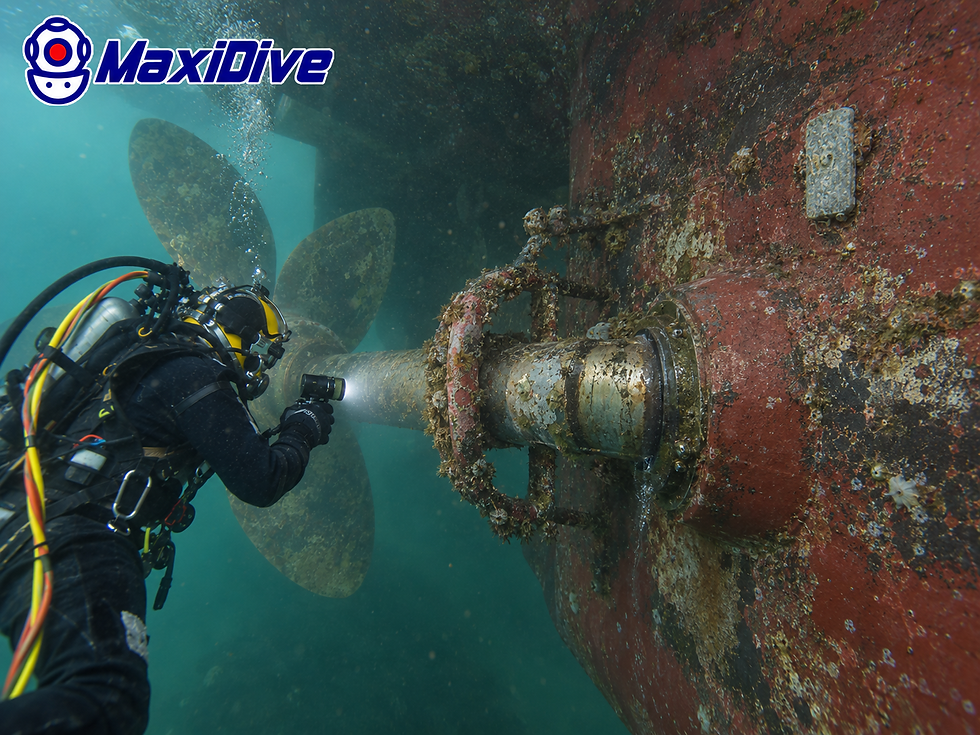
Rope and Fishing-Line Entanglement
Entanglement is one of the most important conditions to check around the propeller shaft.
The commercial diver should look for:
rope;
fishing line;
netting;
plastic line;
wire;
other debris wrapped around the guard or shaft.
Even relatively small amounts of line should be documented because the material can migrate further into the propulsion arrangement.
The inspection should also determine whether the material is located only on the rope guard or extends toward the visible shaft and seal region.
Rope Guard Structural Condition
The rope guard itself should be assessed for visible mechanical condition.
Important observations include:
deformation;
bent structural members;
broken sections;
missing parts;
damaged supports;
abnormal gaps;
visible cracking;
loose-looking components;
impact marks.
Overview photographs are useful for showing the overall geometry, while close-up images can document individual areas of concern.
Welds and Attachment Areas
Where visible, welds and rope guard attachment points should be inspected carefully.
The commercial diving team should look for:
visible cracking;
separation;
coating disruption;
corrosion around weld lines;
deformation;
abnormal movement;
mechanical impact.
Underwater visual inspection can identify visible abnormalities, but it does not replace specialist NDT where structural integrity requires further investigation.
Corrosion and Coating Condition
Protective coating around the rope guard and stern structure may deteriorate over time.
Inspection should document:
coating breakdown;
exposed steel;
rusting;
surface corrosion;
abrasion;
localized mechanical damage;
marine growth over the coating.
The distinction between coating damage and structural damage is important.
Surface coating loss alone does not necessarily indicate structural failure, but it should still be recorded for maintenance planning.
Stern Tube Area
The stern tube carries the propeller shaft through the aft section of the vessel.
Much of the stern tube system is internal and cannot be assessed through an external underwater visual inspection.
However, the commercial diver can document accessible external areas around the stern tube and shaft exit.
This may include:
external housing;
visible shaft area;
external seal region;
surrounding hull structure;
fasteners or retaining components where visible;
marine growth;
external corrosion;
signs of impact.
The inspection should describe only what can actually be seen underwater.
Visible Propeller Shaft Condition
Where the shaft is externally accessible, the commercial diver can document its visible surface.
Inspection may consider:
marine growth;
rope or line contact;
surface corrosion;
unusual marks;
mechanical contact;
visible surface damage.
The visible shaft area should normally be photographed together with the rope guard and propeller so technical personnel can understand the relationship between the components.
External Seal Area
The external stern seal region is another important inspection point.
The diver may document:
external physical condition;
surrounding marine growth;
visible damage;
abnormal gaps;
displaced external components;
visible oil leakage or unusual discharge;
surrounding hull condition.
A visual inspection cannot confirm internal seal integrity.
If no external leakage is visible, the report should state that no visible leakage was observed rather than conclude that the complete stern tube sealing system is fault-free.
Why Visible Leakage Matters
Visible leakage around the stern arrangement may require additional technical review.
During underwater inspection, the diving team should document any unusual visual indication around the external seal region.
Useful evidence includes:
close-up photographs;
continuous video;
location reference;
relationship to the shaft;
surrounding water condition.
The diving team provides the external visual evidence; diagnosis of the sealing system remains a separate technical process.
Marine Growth Around the Stern Arrangement
Marine growth can make inspection difficult around the rope guard and stern tube.
Common growth may include:
slime;
algae;
barnacles;
tube worms;
calcareous deposits.
Heavy marine growth can obscure welds, structural members and the visible shaft.
Where visibility is restricted, the documentation should make that limitation clear.
A component should not be described as being in satisfactory condition if the relevant surface could not actually be seen.
Mechanical Contact and Deformation
The stern arrangement can be exposed to external contact from floating debris, fishing gear or other objects.
The inspection should look for:
bent rope guard members;
impact marks;
displaced components;
scraped coating;
exposed steel;
deformation;
abnormal structural alignment.
Wide-angle imagery is particularly important because localized close-ups may not show whether the overall guard geometry remains normal.
Relationship to the Propeller
The rope guard and stern tube cannot be assessed completely in isolation from the propeller.
A useful underwater survey should also document nearby:
propeller hub;
boss area;
blade roots;
visible shaft section;
rope guard clearance;
surrounding stern structure.
This provides technical personnel with a complete visual context of the propulsion arrangement.
Propeller Blade Condition
When the inspection includes the wider propulsion system, accessible propeller blades can also be reviewed for:
mechanical contact;
dents;
bent edges;
cracks;
cavitation-related erosion;
surface roughness;
marine deposits.
These observations are separate from the rope guard condition but can provide additional information about the overall stern arrangement.
Signs of Entanglement Without Visible Rope
A rope or fishing line may not always remain present when the vessel is inspected.
Possible indications of previous contact can include:
scraped coating;
polished or rubbed metal;
disturbed marine growth;
line marks;
localized wear.
These indications should be documented carefully without automatically attributing them to a specific cause.
The correct approach is to record the visible condition and allow the technical team to evaluate the evidence.
Photo and Video Documentation
Professional underwater documentation should include both overview and close-up records.
Overview images establish:
component location;
general configuration;
relationship between rope guard, shaft and propeller;
overall structural condition.
Close-up images document:
welds;
corrosion;
coating damage;
entanglement;
fasteners;
seal area;
individual abnormalities.
Underwater video is also valuable for showing the full route around the stern arrangement and providing spatial context.
Why Multiple Viewing Angles Matter
Stern components have complex geometry.
A single photograph may hide important details behind the propeller, shaft or guard structure.
Where conditions allow, the commercial diver should document the assembly from several angles.
This can help reveal:
hidden rope or fishing line;
deformation on the opposite side;
damaged supports;
marine growth behind the guard;
abnormalities close to the hull.
Multiple viewing angles create a much stronger technical record.
Inspection After Rope Entanglement
When a vessel has reported suspected rope or net contact, the inspection should cover more than simply confirming whether material remains present.
Important areas include:
rope guard;
visible shaft;
external seal region;
propeller hub;
propeller blade roots;
nearby rudder areas where relevant.
The purpose is to document whether visible evidence of contact remains after the incident.
Inspection After Grounding or Mechanical Contact
The stern arrangement may also be included in a post-grounding or suspected-contact survey.
Depending on the incident, the commercial diving team can document:
rope guard deformation;
shaft area condition;
propeller condition;
stern plating;
rudder;
external seal region.
This allows technical personnel to review the propulsion system together with other underwater components affected by the event.
What Underwater Visual Inspection Cannot Confirm
A professional report should clearly distinguish visual evidence from internal mechanical assessment.
Underwater inspection cannot independently confirm:
stern tube bearing condition;
shaft alignment;
internal seal condition;
bearing clearance;
internal lubrication condition;
internal vibration source;
machinery alignment.
These require appropriate onboard testing, measurement or engineering investigation.
The diving team’s role is to document visible external condition accurately.
Why Repeat Documentation Is Valuable
A single inspection shows condition at one point in time.
Repeated underwater surveys allow technical teams to compare:
corrosion progression;
coating deterioration;
marine growth;
rope guard condition;
external seal appearance;
previous mechanical marks.
Consistent photographs from similar positions make future comparisons considerably more useful.
Underwater Rope Guard and Stern Tube Inspection in Thailand
MaxiDive provides professional underwater inspection support for commercial vessels operating in Thailand.
Inspection capabilities include:
rope guard inspection;
stern tube external inspection;
visible propeller shaft assessment;
external seal area documentation;
propeller inspection;
rudder inspection;
rope and fishing-line inspection;
underwater CCTV;
technical photography and video;
general hull and appendage condition surveys.
Operations are planned according to vessel configuration, inspection purpose, accessibility and underwater visibility.
Clear Evidence Around the Propulsion System
The rope guard, stern tube area and visible shaft components form a critical part of the vessel’s underwater propulsion arrangement.
A professional rope guard inspection Thailand can document entanglement, corrosion, coating condition, deformation, external seal appearance and visible shaft condition without requiring drydocking.
Clear underwater photographs and video provide shipowners, vessel managers and technical superintendents with practical evidence for maintenance planning, incident assessment and future condition comparison.
MaxiDive — We work under pressure.
Internal Links
Need underwater inspection of the rope guard, stern tube, visible shaft or propeller system in Thailand?
Contact MaxiDive for professional commercial diving inspection, underwater CCTV and technical photo/video documentation at Thai ports and anchorages.


Comments