


Underwater Inspection Kerry Siam Sea Port: Hull, Propeller, Rudder and ICCP Condition


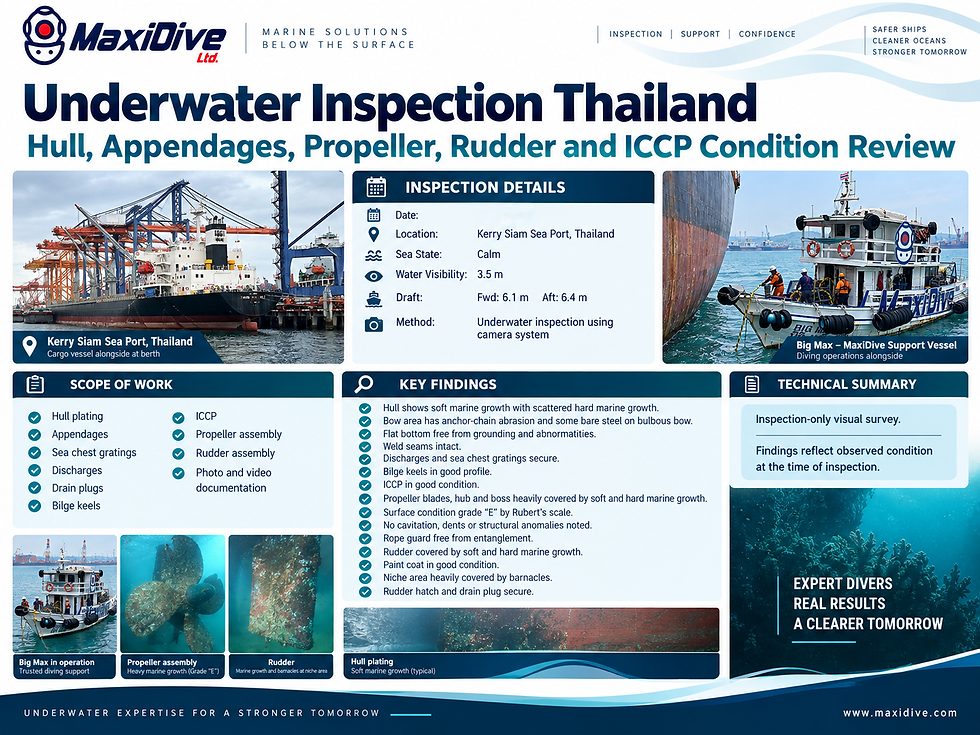
MaxiDive recently completed a professional underwater inspection Kerry Siam Sea Port operation for a commercial vessel in Thailand.
The inspection covered the accessible underwater hull, appendages, ICCP components, propulsion system and rudder assembly, providing the vessel’s technical team with direct visual evidence of submerged condition.
Sea conditions were calm, with underwater visibility of approximately 3.5 metres. A professional underwater camera system was used to document both general condition and localized observations.
The resulting records provide a practical technical reference for condition monitoring, maintenance planning and future comparison.

Underwater Inspection Kerry Siam Sea Port for Vessel Condition Assessment
The commercial diving team carried out a systematic underwater visual inspection covering the principal accessible components below the waterline.
The inspection scope included:
hull plating;
bulbous bow;
vertical sides;
flat bottom;
weld seams;
bilge keels;
transducers;
sea chest gratings;
underwater discharges;
drain plugs;
ICCP components;
propeller blades;
propeller hub and boss;
stern tube;
rope guard;
rudder assembly;
rudder niche area;
rudder hatch and drain plug.
Close-range camera documentation was used to record component condition and individual observations for technical review.
Hull Plating and Marine Growth Condition
The underwater hull showed generally light marine growth across much of the accessible plating.
Soft marine growth consisted mainly of slime and algae, with scattered areas of harder marine growth including barnacles and juvenile barnacles.
Although marine growth was present, the general condition of the visible coating remained satisfactory across most accessible areas.
Documenting both growth level and coating condition is useful because surface coverage can affect how clearly underlying steel and paint condition can be assessed.

Bulbous Bow and Coating Abrasion
Localized coating loss was observed around the bow area.
The visible pattern was consistent with abrasion in the anchor-chain contact zone, with sections of bare steel exposed on the bulbous bow.
The surrounding accessible coating remained in generally good visible condition.
This type of localized observation is important because it allows the vessel’s technical team to distinguish isolated mechanical abrasion from broader coating deterioration.
Flat Bottom Inspection
The accessible flat-bottom areas were inspected for signs of grounding, contact damage and structural abnormality.
No visible grounding indications were identified.
The accessible topcoat and weld seams appeared intact, with no significant structural abnormalities documented during the visual inspection.
No concave weld seams were observed in the areas examined.
Flat-bottom documentation provides a useful condition reference because this part of the hull cannot normally be assessed from above the waterline.
Bilge Keel Condition
Visible bilge keel sections maintained a normal profile.
No significant contact damage or abnormal deformation was observed on the accessible areas.
Bilge keel inspection is particularly useful during general underwater condition surveys because these structures project from the hull and may be exposed to mechanical contact during vessel operations.
Sea Chest Gratings and Underwater Fittings
The commercial diving team inspected accessible sea chest gratings and associated underwater fittings.
The visible gratings appeared secure and correctly positioned.
Additional components assessed included:
underwater discharges;
drain plugs;
transducers;
surrounding hull areas.
Visible discharges showed no significant abnormalities.
Accessible drain plugs remained secure, with no visible leakage identified.
Transducers also appeared securely positioned during the inspection.
ICCP Condition Assessment
Accessible ICCP components were included in the underwater inspection.
The visible components appeared in good general condition, with no significant contact damage or other obvious abnormalities identified.
ICCP visual inspection can help document:
physical condition;
secure positioning;
mechanical damage;
surrounding coating condition;
visible corrosion;
marine growth;
evidence of impact.
Visual inspection does not replace electrical testing of the cathodic protection system, but it provides useful evidence of the external physical condition of accessible components.

Propeller Assembly Inspection
The propeller assembly was systematically inspected, including accessible:
propeller blades;
hub;
boss area;
stern tube;
rope guard;
visible sealing components.
The blades, hub and boss showed heavy coverage by both soft and hard marine growth.
Despite the marine growth, accessible areas were documented to establish the visible condition of the propulsion assembly.
Propeller Surface Roughness
The visible propeller surface condition was assessed using the Rubert comparator system.
Surface roughness was recorded at approximately Grade E on the Rubert Scale.
Surface roughness is an important technical observation because it provides a standardized reference for propeller surface condition and future comparison.
The inspection record allows vessel managers to monitor changes in propeller condition over time rather than relying only on general visual descriptions.
Propeller Blade Structural Condition
Accessible propeller blade areas were inspected for signs of:
cracking;
dents;
mechanical contact;
edge damage;
cavitation-related damage;
abnormal deformation;
other visible structural irregularities.
No significant visible cracking, denting, cavitation damage or structural abnormalities were identified in the accessible blade areas.
The observed condition was documented through close-range underwater imagery.
Stern Tube and Rope Guard
The accessible stern tube area showed no significant visible structural abnormalities.
The rope guard was also inspected and found free from visible rope or line entanglement.
Visible sealing plugs appeared securely positioned.
These observations are useful because entanglement, damaged rope guards and abnormal stern-tube conditions can affect propulsion-system operation and may require further technical review.
Rudder Assembly Inspection
The rudder assembly showed substantial coverage by soft and hard marine growth.
Despite the surface coverage, accessible rudder areas were visually documented for coating, structural condition and visible fittings.
The general paint coating appeared in good visible condition.
No significant contact damage or structural abnormality was observed on accessible rudder surfaces.
Rudder Niche Area
Heavy barnacle coverage was observed inside the accessible rudder niche area.
Marine growth in niche areas is particularly important to document because it can obscure structural surfaces and reduce visual access to underlying components.
Where growth limits visibility, the inspection record should clearly identify the limitation rather than assume satisfactory underlying condition.
Rudder Hatch and Drain Plug
The accessible rudder inspection hatch appeared securely positioned.
The visible drain plug was also secure.
Recording these smaller components is important during a systematic underwater survey because loose or missing fittings may otherwise be missed in a general overview of the rudder.
What the Inspection Documented
The underwater inspection recorded several useful technical observations:
light soft marine growth across much of the accessible hull;
scattered barnacles and juvenile barnacles;
localized coating abrasion around the bow;
exposed steel on parts of the bulbous bow;
no visible grounding indications on accessible flat-bottom areas;
intact visible weld seams;
normal bilge keel profile;
secure sea chest gratings;
secure drain plugs;
no significant visible discharge or transducer abnormalities;
ICCP components in good visible condition;
heavy marine growth on propeller blades, hub and boss;
propeller surface roughness approximately Grade E on the Rubert Scale;
no significant visible propeller cracking, denting or cavitation damage;
stern tube without notable visible structural abnormalities;
rope guard free from entanglement;
heavy marine growth on the rudder and niche area;
generally satisfactory visible rudder coating condition.
Together, these findings provide a structured underwater condition reference for the vessel’s technical team.
Why Technical Underwater Documentation Matters
Professional underwater inspection is most valuable when observations are supported by clear visual documentation.
A useful inspection record combines:
component overview images;
close-range photographs;
CCTV or video records;
clear identification of observed condition;
documentation of abnormalities;
acknowledgement of areas where visibility is restricted.
This allows technical superintendents and vessel managers to review the condition after the operation and compare it with future inspection records.
Commercial Vessel Inspection in Thailand
MaxiDive provides professional underwater inspection services for commercial vessels operating in Thailand.
Inspection capabilities include:
hull condition inspection;
flat-bottom inspection;
propeller inspection;
rudder inspection;
sea chest inspection;
ICCP inspection;
underwater appendage assessment;
anode inspection;
CCTV-supported visual inspection;
underwater measurements where required;
technical photo and video documentation.
Each inspection scope is coordinated according to vessel requirements, accessibility, underwater visibility and the technical purpose of the survey.
Clear Evidence Below the Waterline
A structured underwater condition survey gives vessel managers direct visual evidence of components that cannot be effectively assessed from above the waterline.
During this underwater inspection Kerry Siam Sea Port operation, MaxiDive documented hull plating, appendages, ICCP components, the propeller assembly and rudder condition under calm sea conditions.
The resulting technical documentation provides a practical reference for condition monitoring, maintenance planning and future comparison.
MaxiDive — We work under pressure.
Internal Links
Need professional underwater inspection at Kerry Siam Sea Port or another location in Thailand?
Contact MaxiDive for underwater hull, propeller, rudder, ICCP and appendage inspection supported by professional photo and video documentation.


Comments