


Underwater Bow Thruster Inspection Thailand: What to Check on Tunnel, Blades, Grids and Anodes

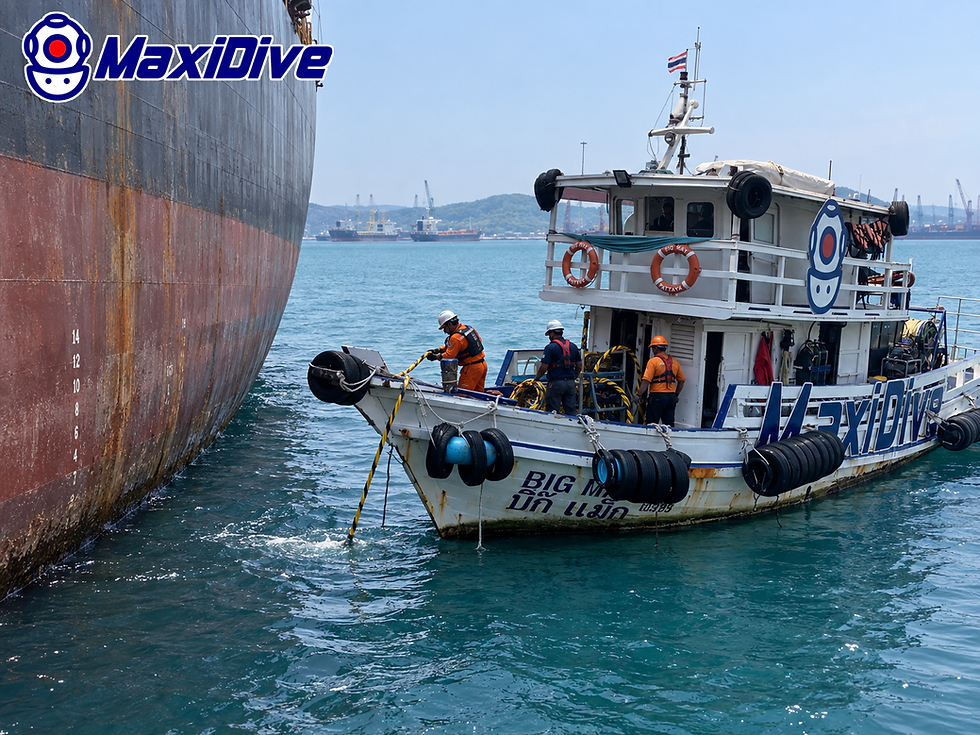
A bow thruster inspection needs to show more than a clear view of the tunnel entrance. Vessel managers need useful information about the accessible tunnel surfaces, propeller blades, protective grids and anodes, together with a clear record of anything that could not be inspected.
An underwater bow thruster inspection in Thailand can support condition assessment, investigation of reported abnormalities and maintenance planning. Its value depends on an agreed scope, suitable access and documentation that separates visible observations from issues requiring further examination.
MaxiDive provides commercial underwater inspection services for vessel operators in Thailand. Bow thruster inspections can form part of a wider hull survey or focus on specific concerns identified by the vessel’s technical team.

Underwater Bow Thruster Inspection Thailand: Establish the Scope First
Bow thruster arrangements vary between vessels. Tunnel dimensions, propeller configuration, protective grids and anode locations should be checked against the available drawings and equipment information.
Before attendance, identify the purpose of the inspection. This may include documenting general condition, investigating suspected contact damage, checking visible obstructions or reviewing areas highlighted in an earlier report.
A practical scope should identify:
The thruster unit and tunnel openings to be inspected.
Accessible tunnel surfaces, blades, hub and external housing.
Protective grids and their attachments, where fitted.
Anode locations shown in the relevant drawings.
Required photographs, video and any separately agreed measurements.
Known access restrictions and reporting requirements.
Where a vessel has multiple thrusters, each unit should be clearly distinguished in the inspection record. Observations from one opening should not be presented as confirmation of the condition of the entire installation.

Tunnel: Coating, Visible Corrosion and Local Damage
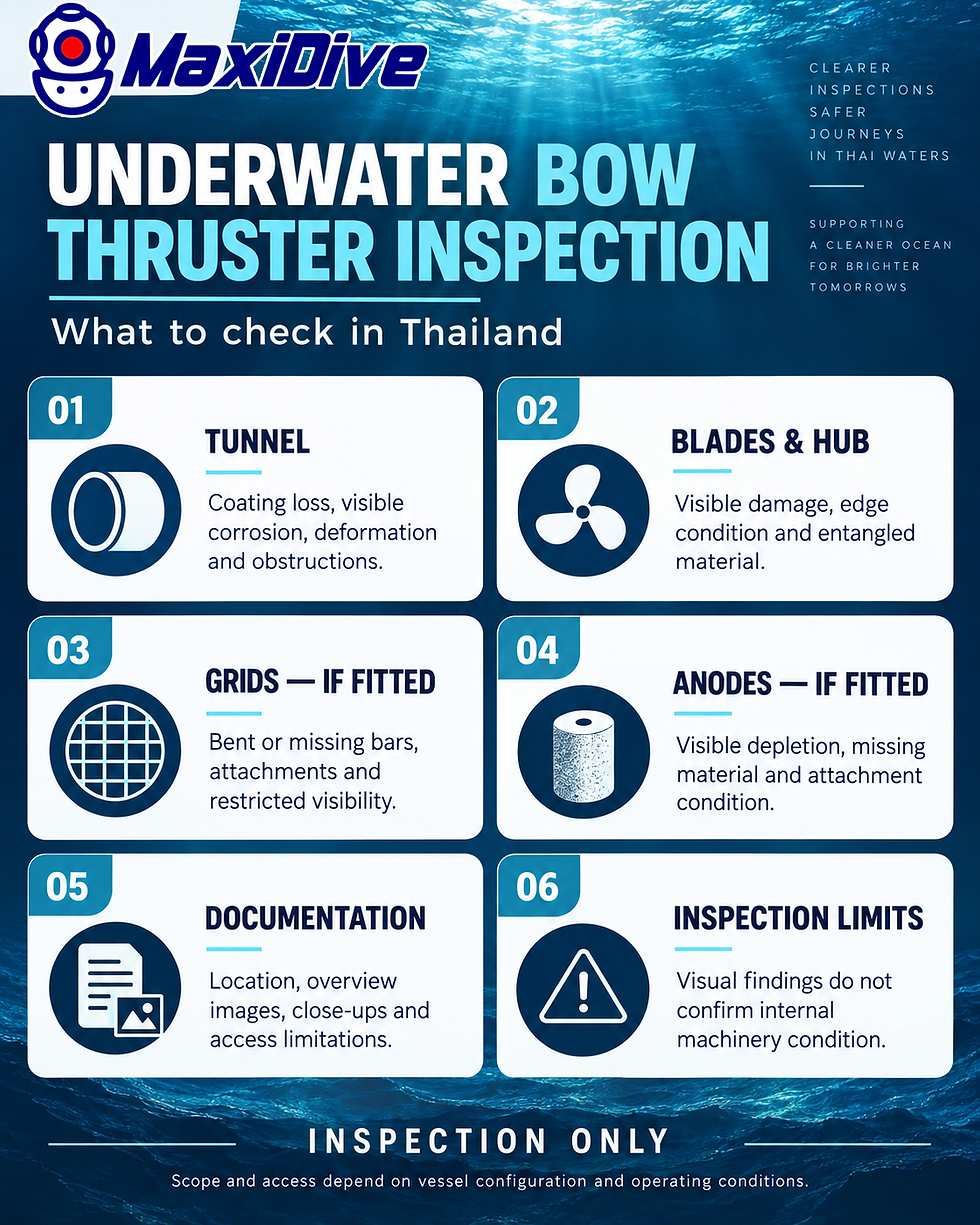
The tunnel inspection should cover the entrance, accessible internal surfaces and surrounding hull coating.
Useful observations include coating loss, exposed metal, visible corrosion, local deformation and material obstructing the opening. Marine growth should also be documented where it affects the view of the underlying surface or restricts access.
Overview images establish the location and extent of an observation. Close-ups then show the surface detail. A close-up without a location reference can be difficult for a technical manager to interpret later.
Visible surface irregularities should be described carefully. A photograph alone does not establish remaining steel thickness, the depth of a pit or the full extent of a suspected crack. Those questions may require separately specified measurements or testing.
The report should identify surfaces hidden by growth, tunnel geometry or restricted camera access. An obscured area should remain recorded as unassessed.

Blades and Hub: Edges, Surface Condition and Obstructions
Accessible blade surfaces should be examined for visible damage, including bent edges, chipped areas, missing material and unusual surface deterioration.
The inspection should also record rope, line or other material visible around the propeller, hub or adjacent housing. Its location matters: an overview helps show the relationship between the material and the surrounding components.
Where access allows, the image sequence should distinguish individual blades and show more than one viewing angle. It should also state when only part of a blade or one face was visible.
Surface marks may justify further investigation, but their appearance alone may not establish the cause. Suspected impact damage, erosion or cracking should be reported with supporting images and appropriate qualifications.
A visual inspection does not confirm propeller balance, internal bearing condition, seal integrity or the operation of a controllable-pitch mechanism. Apparent blade clearance in a photograph is also not a substitute for a measurement performed using an agreed method and the manufacturer’s criteria.
Protective Grids: Bars, Attachments and Visibility
Where protective grids are fitted, their condition forms a separate part of the inspection.
Check for visibly bent or missing bars, damaged attachment areas, corrosion and material caught across the opening. Record any deformation that appears to reduce the space between the grid and internal components.
The report should distinguish an observed attachment defect from a connection whose security has not been tested. Visual appearance alone does not verify bolt torque or the integrity of a concealed connection.
Grid bars can obstruct camera angles and hide parts of the blades or tunnel. These limitations should be recorded explicitly.
Not every tunnel thruster installation has protective grids. Their absence should be assessed against the vessel’s documented arrangement before being described as missing equipment. Grid removal is a separate activity and should not be assumed to form part of a visual inspection.

Anodes: Visible Depletion and Attachment Condition
Where sacrificial anodes are fitted, the inspection should compare visible locations with the available arrangement information.
Record visible depletion, uneven consumption, missing material and the condition of accessible attachment points. Note any coating or deposits covering an anode and any nearby visible corrosion.
Images should show both the anode and its position within the tunnel. Previous photographs or original dimensions can help support comparison, provided they relate to the same component.
An exact remaining-life estimate should not be inferred from appearance alone. Replacement criteria depend on the anode design, original dimensions, operating conditions and applicable equipment guidance.
Similarly, an anode that remains visibly present does not by itself demonstrate that cathodic protection is effective. Electrical continuity and protection performance require suitable assessment beyond a photographic condition record.

Inspection Planning in Thailand
Attendance should be coordinated around the vessel’s location, available working window, draft, access arrangements and concurrent operations.
For port attendance, the service described here is underwater inspection. Requests involving physical intervention require separate assessment and should not be assumed to be included.
Before diving, the vessel and diving team must agree and verify the necessary machinery isolations and controls under the applicable procedures. The inspection plan must address the thruster and other relevant underwater hazards.
Tunnel entry should never be treated as an automatic part of the scope. Access must be assessed for the particular installation, and the team should record when safe positioning or equipment reach prevents further examination.
Weather, current, visibility and local operating requirements can affect attendance and coverage. These factors should be considered before scheduling and reflected in the final report where relevant.
What the Inspection Report Should Contain
A useful report connects each observation to a clearly identified component and location.
The documentation should include:
The agreed scope and the areas actually inspected.
Identification of the thruster unit and viewing side.
Overview photographs and relevant close-ups.
Descriptions of visible damage, deterioration or obstruction.
Measurements only where included and completed.
Visibility, access and coverage limitations.
Items requiring further technical assessment.
Statements such as “no visible damage observed on the accessible surfaces” communicate the extent of the finding more accurately than an unrestricted statement that the thruster is in good condition.
Where the inspection supports a class-related requirement, the scope, documentation and any surveyor involvement should be established in advance. Completion of a visual inspection does not automatically constitute class acceptance or operational clearance.
Using the Findings for Maintenance Decisions
The underwater report should be considered alongside the vessel’s operating history, previous inspections and relevant machinery information.
Reported vibration, unusual noise or reduced thrust may help direct attention to particular areas. An external inspection can document visible conditions, but it may not establish the cause of an operational problem.
Clear findings help the technical team decide whether further examination, manufacturer advice or a separate maintenance scope is needed. Photographs are most useful when they show where an observation was made and explain what remains uncertain.
Frequently Asked Questions
Can a bow thruster be inspected without dry-docking?
Accessible external areas can often be inspected while the vessel remains afloat. Feasibility and coverage depend on the installation, safe access, operating conditions and the agreed scope.
Can every blade be fully inspected through a protective grid?
Not necessarily. Grid spacing, blade position and camera access may prevent a complete view. The report should identify which surfaces were observed and which remained obscured.
Does the inspection include cleaning or removing obstructions?
The scope described in this article is inspection only. Any physical intervention requires separate assessment and agreement.
Can underwater photographs confirm that anodes are working correctly?
Photographs can document visible condition and depletion. They do not independently verify electrical continuity or cathodic protection performance.
What should vessel managers send before booking?
Provide the proposed location, attendance window, vessel particulars, thruster arrangement information, inspection objective and reporting requirements. Previous observations and relevant drawings help define the scope.
Arrange a Bow Thruster Inspection with MaxiDive
Discuss the inspection objective with MaxiDive before attendance so that the scope addresses the vessel’s technical priorities.
Send the proposed location, available working window, relevant drawings and any known concerns to info@maxidive.com, or use the Contact MaxiDive page.
Explore Underwater Inspections & Surveys for broader hull and underwater component assessment.
Related MaxiDive Services
Service availability and scope depend on location, permissions and operating conditions.


Comments