


In-Water Survey Thailand at Songkhla Anchorage: Hull and Azimuth Assembly Inspection


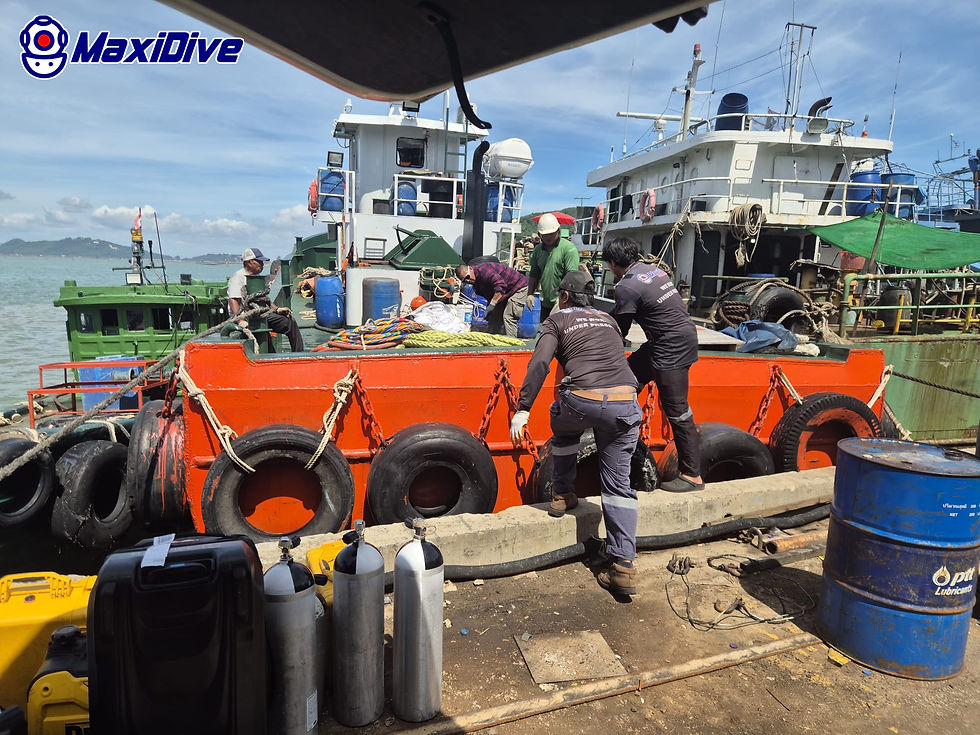
MaxiDive recently completed a professional in-water survey Thailand operation for a commercial vessel at Songkhla Anchorage.
The inspection was carried out by a surface-supplied commercial diving team using HD CCTV equipment and underwater inspection tools to document accessible hull plating, underwater appendages, sea chest gratings, discharges, drain plugs and azimuth propulsion assemblies.
Sea conditions were calm, while underwater visibility was below approximately two metres. The commercial diving team therefore worked systematically at close range to obtain clear visual evidence of the vessel’s submerged components.
The resulting underwater photographs, CCTV footage and technical observations provided the vessel’s technical team with a structured condition record for review and future comparison.

In-Water Survey Thailand for Vessel Condition Assessment
An in-water survey Thailand provides vessel managers and technical superintendents with direct visual access to submerged components while the vessel remains afloat.
Depending on vessel configuration and the agreed inspection scope, an in-water survey may document:
underwater hull plating;
weld seams;
coating condition;
underwater appendages;
sea chest gratings;
transducers;
overboard discharges;
drain plugs;
propulsion components;
rudder or steering systems;
azimuth propulsion assemblies;
other accessible underwater fittings.
The objective is to create clear and traceable underwater evidence of visible condition rather than rely solely on verbal observations from the diving team.

Underwater Hull Plating Inspection
Hull plating formed an important part of this survey.
The accessible underwater hull was systematically examined for visible indications of:
pitting;
deformation;
indentation;
abnormal weld seams;
mechanical damage;
coating deterioration;
corrosion;
marine fouling.
Marine fouling was visible across significant areas of the underwater hull.
Despite the fouling coverage, the inspection did not identify significant visible structural damage in the accessible areas examined.
The visible topcoat generally remained in good condition, and accessible weld seams appeared intact.
This combination of general and close-range CCTV footage provides vessel managers with useful evidence for condition monitoring between scheduled maintenance periods.
Marine Fouling and Inspection Visibility
Marine fouling can significantly influence how an underwater inspection is performed.
Growth on hull plating and underwater components can make close-range assessment more difficult, particularly where visibility is already limited.
During this operation, underwater visibility was below approximately two metres.
The commercial diver therefore worked close to the vessel surface, using controlled movement and camera positioning to document the required components.
Where necessary, localized marine growth around specific inspection points was cleared to obtain visual access to the component beneath.
Accurate reporting should distinguish between the condition of the component itself and the marine growth present on its surface.

Underwater Appendage Inspection
Accessible underwater appendages were also documented during the survey.
The inspection covered relevant fittings and components including transducer areas, sea chest gratings, discharges and drain plugs.
The visible transducer areas showed no obvious abnormalities during inspection.
Accessible sea chest gratings were checked for security and condition, including visible fastening arrangements.
Visible overboard discharge areas were also examined for signs of physical damage.
Accessible drain plugs appeared secure and intact.
These observations were supported by underwater visual documentation so that the vessel’s technical personnel could review the findings after completion of the diving operation.

Sea Chest Grating Condition
Sea chest gratings are important inspection points because they remain continuously submerged and are exposed to marine growth and environmental conditions.
During the survey, accessible gratings were visually assessed for:
security;
fastening condition;
deformation;
visible damage;
marine fouling;
surrounding hull condition.
Localized growth was cleared where necessary to allow the gratings and fastening areas to be viewed more effectively.
The accessible gratings were found secured in position during the inspection.
Photo and video documentation provide a useful permanent reference for comparison during future underwater surveys.
Azimuth Assembly Inspection
A particularly important element of this project was inspection of the vessel’s azimuth propulsion assemblies.
Azimuth propulsion units combine propulsion and steering functions, making their underwater condition particularly important for vessel operations.
The diving team systematically documented the accessible port and starboard assemblies.
Inspection coverage included visible areas of:
propeller blades;
propulsion unit surfaces;
surrounding structure;
coating condition;
potential rope or line entanglement;
other accessible propulsion components.
Both assemblies showed substantial marine fouling coverage.
However, no visible rope or line entanglement was observed during the inspection.
Propeller Condition on the Azimuth Units
The propellers associated with the azimuth propulsion units were examined for visible indications of significant damage.
The commercial diver documented accessible blade surfaces and edges using underwater CCTV.
No obvious cracks or significant visible blade damage were observed in the accessible areas examined.
The visible coating condition around the propulsion assemblies was also generally satisfactory.
For vessel managers, this type of close-range propeller documentation provides a practical reference for monitoring propulsion-system condition while the vessel remains in service.
Why Azimuth Propulsion Documentation Matters
Azimuth propulsion systems operate in a demanding underwater environment.
Marine growth, foreign-object contact, rope entanglement, coating deterioration and blade damage are among the visible conditions that may be identified during underwater inspection.
A systematic inspection can provide evidence of:
blade condition;
visible mechanical damage;
entanglement;
marine fouling;
coating condition;
external propulsion-unit condition.
Underwater inspection does not replace internal mechanical assessment or engineering diagnostics.
Instead, it provides direct evidence of the externally visible condition of submerged components.
CCTV Inspection in Reduced Visibility
Water visibility can vary significantly at anchorages and operating locations.
When visibility is reduced, inspection quality depends heavily on diver positioning, camera distance and systematic component identification.
For this survey, HD underwater CCTV allowed the surface team to follow the inspection while the commercial diver worked close to the vessel structure.
Real-time communication enabled the inspection team to:
confirm the component being examined;
request closer views;
verify inspection coverage;
record specific findings;
obtain additional footage where required.
Recorded CCTV also allows technical personnel to review individual components again after the diving operation has finished.
Technical Photo and Video Documentation
Professional in-water survey reporting should provide more than a written summary.
Useful documentation can include:
hull overview footage;
close-range hull plating images;
weld seam documentation;
underwater appendage photographs;
sea chest grating views;
discharge and drain plug documentation;
propulsion-unit footage;
propeller blade close-ups;
selected technical findings.
Combining wide views with detailed close-ups helps establish both the location and condition of the component being inspected.
This creates a more practical record for vessel managers and technical superintendents.
In-Water Survey at Songkhla Anchorage
Songkhla is an important operating area for commercial and offshore-support vessels in southern Thailand.
MaxiDive supports vessels at Songkhla and other Thai operating locations with professional underwater inspection and technical documentation.
Depending on vessel requirements, inspection capabilities include:
in-water survey;
underwater hull inspection;
CCTV inspection;
propeller inspection;
rudder inspection;
azimuth propulsion inspection;
sea chest inspection;
underwater appendage assessment;
underwater measurements where required;
photo and video documentation;
technical reporting.
Every project is planned according to vessel configuration, underwater conditions, accessibility and the agreed inspection scope.
A Clear Record Below the Waterline
An in-water survey provides technical teams with something that cannot be obtained from above the waterline: direct visual evidence of the vessel’s submerged condition.
For this Songkhla Anchorage operation, the inspection documented hull plating, underwater appendages, sea chest gratings and azimuth propulsion assemblies under calm sea conditions and reduced underwater visibility.
The resulting CCTV footage and technical records provide a useful reference for vessel condition assessment, maintenance planning and future comparison.
MaxiDive provides professional in-water survey Thailand services using experienced commercial diving teams, surface-supplied diving systems and HD underwater CCTV documentation.
MaxiDive — We work under pressure.
Internal Links
Need an in-water survey or underwater condition assessment for your vessel in Thailand?
Contact MaxiDive for professional hull, propulsion, sea chest and underwater appendage inspection supported by CCTV, photo documentation and technical reporting.


Comments