


In-Water Survey CCTV Thailand for Underwater Vessel Condition Assessment

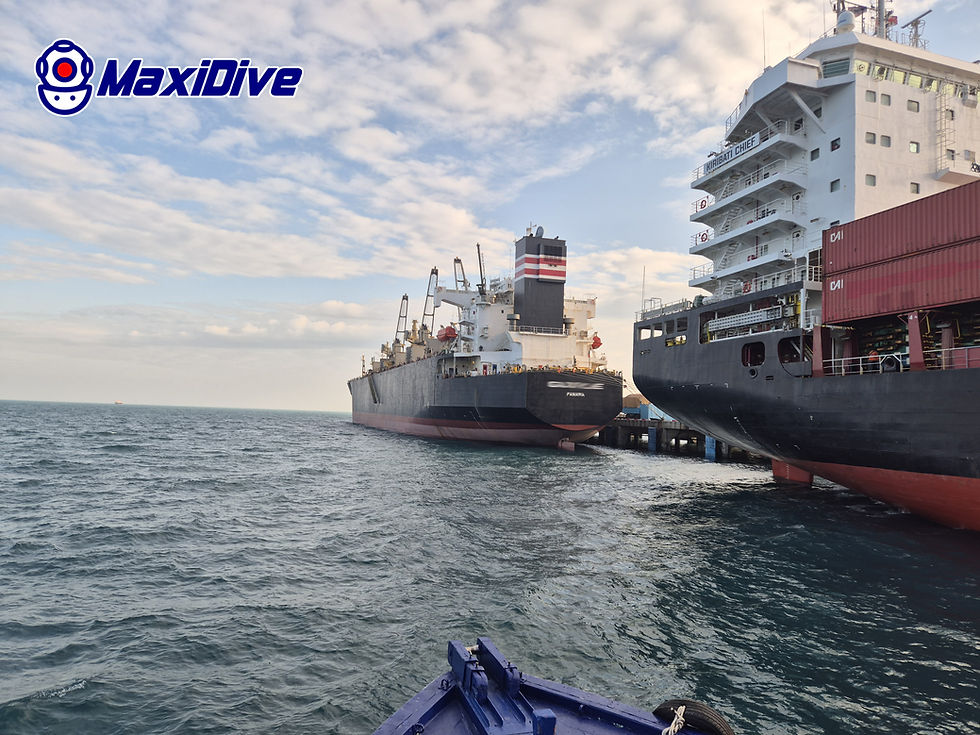
MaxiDive Co., Ltd. completed an in-water survey CCTV Thailand project at Sriracha Harbour, Thailand. The operation was carried out as a CCTV-supported underwater survey to document the vessel’s hull plating, appendages, sea chest gratings, emergency fire pump sea chest, discharges, drain plugs, anodes, propeller assemblies, rope guard, and rudder system.
The survey was performed for class-related and technical review, using professional underwater inspection equipment including an SSDE system and HD 4K CCTV system. This type of in-water survey allows vessel owners, managers, and class representatives to assess underwater condition while the vessel remains afloat.

In-Water Survey CCTV Thailand Scope
The in-water survey CCTV Thailand scope included a structured underwater inspection of the main hull and underwater components. MaxiDive’s diving team documented visible condition, coating condition, weld seam condition, blockage status, propeller roughness, rudder movement, and potential abnormalities.
The inspection covered:
bulbous bow condition;
flat bottom plating;
vertical side shell plating;
bilge keels;
transducers;
high and low sea chest gratings;
emergency fire pump sea chest grating;
discharges;
drain plugs;
anodes;
propeller assemblies;
rope guard;
measuring plugs;
rudder assembly and inspection door;
underwater CCTV documentation.
The work was performed under moderate sea conditions with approximately 4 meters of underwater visibility, allowing the diving team to document the inspected areas clearly.

Hull Plating Condition Findings
The bulbous bow was reported in excellent condition. The topcoat was intact, weld seams were secure, and no contact damage or abnormalities were noted.
The flat bottom was also found in excellent condition, with secure and intact weld seams. The topcoat condition was reported as excellent, with no visible grounding evidence, no surface corrosion, and no abnormalities observed.
The vertical side topcoat was reported in excellent condition and free from surface corrosion or abnormalities. Overall, the hull plating was found clean, with only a light layer of marine fouling noted during the survey.
These findings provide useful underwater evidence for vessel technical teams and class-related review, especially when confirming hull condition without dry docking.
Appendage and Sea Chest Inspection
The bilge keels on both port and starboard sides were reported in excellent condition. The topcoat was intact, weld seams were secure, and no damage or abnormalities were noted.
The transducers were secure, with no abnormalities reported. The high and low sea chest gratings were secure and fastened in place. The gratings were free from blockage after cleaning by divers.
The emergency fire pump sea chest was also found secure and fastened, with the grating free from blockage after diver cleaning. Discharge openings were free from blockage, and no abnormalities were noted.
Drain plugs were secure and intact, with no leakage reported. The anodes were secure and active in place.
Propeller Assembly Inspection
The propeller assemblies were found free from entanglements. The external rope guard was found in good condition, with intact weld seams and no damage or abnormalities noted. The report also noted that rope cutters were not installed.
The measuring plugs were secure and fastened in place, with no leakage observed. Propeller surface roughness was recorded as Grade “E”, and the propeller was covered by light soft marine growth.
Minor pitting was identified only on blade “B”. The other blades were reported free from damage and abnormalities. The boss cap was secure and fastened in place, with no abnormalities noted.
Propeller roughness and blade condition documentation are important because they support maintenance planning, fuel-efficiency review, and future propeller polishing decisions.
Rudder Assembly Inspection
During the underwater inspection, no visible rudder movement was observed. The inspection door was secure, with no movement noted.
The rudder anodes were secure and active. The overall weld seams were intact and secure, with no concave welds, pitting, or abnormalities observed. The bottom plug was secure in place, with no leakage reported.
The rudder plate was free from surface corrosion, and the topcoat was found in good condition. Overall, no rudder abnormalities were noted. The upper plate could not be inspected due to the rudder position above the waterline, and this limitation was recorded in the inspection findings.
Class-Related CCTV Inspection Support
The project was carried out under a ClassNK-related inspection context. CCTV-supported in-water surveys require clear communication between divers, supervisors, vessel representatives, and class attendees.
Underwater CCTV inspection helps provide:
live or recorded visual evidence;
clear documentation of inspected underwater areas;
support for class and technical review;
reduced need for immediate dry-dock attendance;
structured condition assessment of hull and appendages;
documented inspection limitations where applicable.
For vessel managers, this type of survey supports better maintenance planning and operational decision-making.
Commercial Diving Support at Sriracha Harbour
Sriracha Harbour is an important operational area for commercial vessels in Thailand. MaxiDive provides in-water surveys, CCTV underwater inspections, hull condition assessments, propeller inspections, rudder inspections, sea chest cleaning, hull cleaning, propeller polishing, and emergency underwater services across Sriracha, Laem Chabang, Koh Si Chang, Sattahip, Map Ta Phut, Bangkok Port, Songkhla, and other locations.
With 2,111 completed projects, 964 clients, 21 locations, and 5 diving units, MaxiDive supports shipowners, managers, class representatives, and technical departments with structured underwater inspection and commercial diving services throughout Thailand.
Conclusion
MaxiDive successfully completed the in-water survey CCTV Thailand project at Sriracha Harbour. The inspection documented the underwater condition of the hull plating, appendages, sea chest gratings, emergency fire pump sea chest, discharges, plugs, anodes, propeller assemblies, rope guard, and rudder system.
The survey confirmed that the main inspected areas were generally in good condition, with excellent hull plating and topcoat findings, clean sea chest gratings after diver cleaning, secure appendages, and no major structural abnormalities reported. Propeller roughness was recorded as Grade “E”, with minor pitting noted only on one blade for maintenance planning.


Комментарии