


Scrubber Inspection Thailand: Underwater OVBD Inspection at Laem Chabang Port

MaxiDive completed a scrubber inspection Thailand project at Laem Chabang Port, Thailand. The operation included underwater inspection of the scrubber overboard discharge area, hull condition assessment, appendage inspection, and propeller polishing support.
The project was performed while the vessel remained afloat, allowing the owner’s representative and technical team to receive underwater condition documentation without dry-docking. The operation was carried out under calm sea conditions, with limited underwater visibility of approximately 0.5 meters.

Scrubber Inspection Thailand for Overboard Discharge Verification
A professional scrubber inspection Thailand operation is important for vessels equipped with exhaust gas cleaning systems, especially when technical teams need to confirm the condition of overboard discharge outlets and surrounding hull structures.
For this project, MaxiDive divers inspected one scrubber overboard discharge located on the starboard stern area. The inspection covered the external shell area and the internal visible section of the pipe up to the butterfly valve installed inside the discharge pipe.
The inspection was documented using underwater photo and video equipment to support technical review and reporting.
Scrubber Overboard Discharge Inspection Results
During the scrubber inspection Thailand operation, MaxiDive divers recorded the following observations:
The scrubber overboard discharge was identified and inspected from the external shell area.
Areas inside the scrubber discharge pipe were visually checked from outside the hull opening.
The top coat around the external shell area and inside the discharge was found in satisfactory condition.
Approximately 60% paint coat loss was observed in the internal area of the scrubber pipe.
Blistering of the remaining top coat was noted in the pipe area.
No corrosion was observed.
The scrubber overboard discharge tube was found free from soft and hard marine growth.
Weld seams were found satisfactory.
No concave weld seams were noted.
No structural abnormalities were detected.
These findings provided the vessel’s technical team with a clear underwater condition record of the scrubber overboard discharge area.
Hull and Scrubber Inspection Thailand – Additional Vessel Condition Findings
In addition to the scrubber overboard inspection, MaxiDive also performed a general underwater hull and appendage inspection.
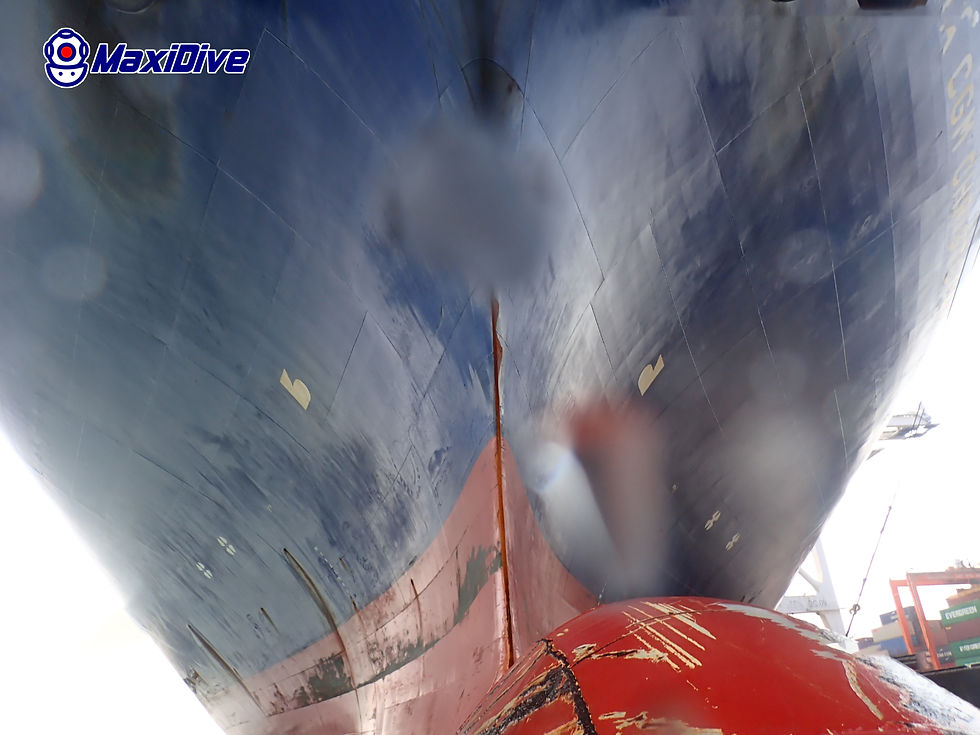
The hull plating was found covered by soft marine growth, mainly algae, on both port and starboard sides. The flat bottom showed hard marine growth, including baby barnacles. Localized loss of top coat was observed in the bow area, consistent with anchor chain abrasion.
Where visible, the paint coating was generally found in satisfactory condition. No surface corrosion, no pitting, no defective weld seams, and no structural anomalies were noted.
This wider inspection scope helped provide a more complete picture of the vessel’s underwater condition during the port call.
Appendage and Sea Chest Inspection
The underwater inspection also included appendages and key underwater fittings.
The bilge keels were found with typical profiles and covered by soft marine growth. Bow thruster gratings on both starboard and port sides were found in place, secure, and without movement. No contact damage was noted.
The sea chest gratings were found secured, although some blockage by hard marine growth was observed. The ICCP system was found secure, and drain plugs were confirmed secure with no anomalies reported.
These observations are important for technical teams because appendages, sea chests, and underwater fittings can affect operational reliability if fouling, blockage, or structural defects are left unidentified.
Propeller Polishing and Rope Guard Cleaning
The project also included propeller polishing and cleaning support.
The propeller blade surfaces were inspected and cleaned using hydraulic tools fitted with 3M Scotch pads. Blade surfaces, blade palms, and hub areas were polished using silica grit polishing disks. Upon completion, the average blade surface roughness was recorded as equivalent to Grade “A” on the Rupert Scale.
The rope guard was found fouled in both inside and outside areas and was cleaned by the attending divers. The stern tube assemblies were found secure and free from structural anomalies or oil leakage.
Professional propeller polishing helps support vessel efficiency by reducing surface roughness and improving hydrodynamic performance.

Why Scrubber Inspection Is Important
Scrubber overboard discharge systems operate in demanding marine conditions and are exposed to seawater, marine growth, coating wear, and potential corrosion risk.
A planned scrubber inspection Thailand service helps shipowners and technical managers:
Verify scrubber discharge outlet condition
Identify coating loss or blistering
Check for corrosion or structural abnormalities
Confirm weld seam condition
Document overboard discharge pipe condition
Support maintenance planning
Reduce the need for unnecessary dry-dock inspection
Maintain reliable vessel operation during port calls
For vessels trading through Thailand, underwater scrubber inspection provides a practical way to collect technical evidence while the vessel remains operational.
Commercial Diving Support at Laem Chabang Port
Laem Chabang Port is one of Thailand’s busiest commercial ports, where vessels often require fast underwater inspection, cleaning, and maintenance support during limited port stays.
This scrubber inspection Thailand project demonstrates MaxiDive’s capability to support shipowners, managers, and technical representatives with:
Scrubber overboard discharge inspection
Hull condition assessment
Propeller polishing
Rope guard cleaning
Sea chest and appendage inspection
Underwater CCTV / photo documentation
Commercial diving support in port conditions
Technical reporting for vessel maintenance records
MaxiDive provides underwater inspection and maintenance services across Thailand’s major ports and anchorages, including Laem Chabang, Sriracha, Sattahip, Bangkok Port, Koh Si Chang Anchorage, Map Ta Phut, and Songkhla.
MaxiDive Underwater Inspection Services in Thailand
MaxiDive delivers professional commercial diving and underwater inspection services for commercial vessels operating in Thailand. Our teams support shipowners, managers, agents, class surveyors, and technical departments with practical underwater solutions that help reduce downtime and support reliable vessel operations.
Our services include:
Scrubber inspection
Underwater hull inspection
In-water survey / UWILD
Propeller polishing
Hull cleaning
Sea chest inspection
Bow thruster inspection
Rudder and propeller inspection
ICCP and anode inspection
Underwater repair and maintenance
CCTV and photographic reporting
Conclusion
This scrubber inspection Thailand project was successfully completed at Laem Chabang Port.
MaxiDive inspected the scrubber overboard discharge area, documented coating condition inside the pipe, confirmed no corrosion and no structural abnormalities, and completed additional hull, appendage, rope guard, and propeller polishing support.
The project provided the vessel’s technical team with reliable underwater documentation while avoiding dry-dock intervention and minimizing operational disruption.
For related services, see Underwater Inspections & Surveys, Hull Cleaning & Propeller Polishing, Commercial Diving Services, Emergency Underwater Repair, or Contact MaxiDive for project support.


Comments